China runs on a phone screen. Whether you're buying a dumpling from a street cart in Xi'an or riding the Shanghai metro, the default — and often the only — way to pay is by scanning a QR code. The good news for 2026: what used to be a maddening puzzle for foreign visitors is now genuinely straightforward. This guide walks you through everything, calmly and in order.
Why China Is Cashless: QR Codes Everywhere
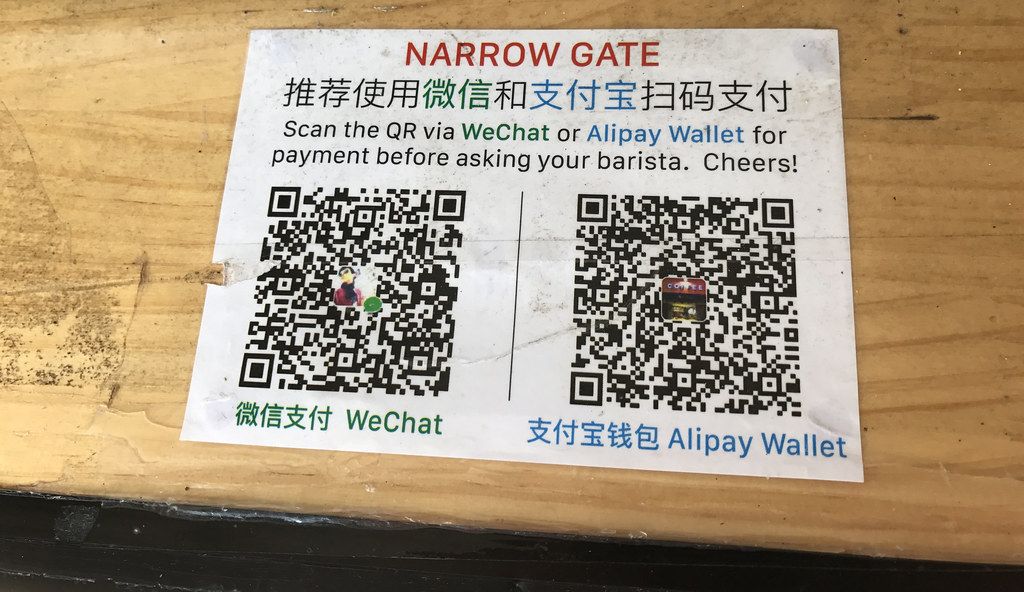
China leapfrogged credit cards entirely and went straight from cash to mobile payments. Today, two apps — Alipay and WeChat Pay — handle the overwhelming majority of daily transactions. You'll see the same little black-and-white QR codes taped to taxi dashboards, glued beside noodle stalls, and printed on temple donation boxes. Many small vendors no longer keep change on hand, and some won't accept paper money at all.
The Chinese government has actively smoothed the path for tourists. Per State Council guidance issued in April 2024, three-star-and-above hotels and 4A/5A-rated attractions are required to accept foreign bank cards and cash, and the payment apps now support international cards directly. Regulators also raised the limits dramatically: a single mobile-payment transaction can now reach US$5,000 (up from $1,000) and your annual cap is US$50,000 (up from $10,000).
Alipay vs. WeChat Pay for Foreigners
Both work. For most first-time visitors, start with Alipay — its foreign-card setup is more polished, its in-app translation now spans 16 languages, and its mini-programs cover taxis, train tickets, and attraction passes. Install WeChat Pay second, both as a backup and because some local merchants and mini-programs prefer it.
Pro tip: Set up both apps before you fly. If one card binding hiccups mid-trip, you'll be glad you have a second wallet already verified and ready.
Step-by-Step: Binding a Foreign Visa/Mastercard
You do not need a Chinese bank account or a Chinese phone number — just your passport, a home-country mobile number, and a supported card. Alipay accepts Visa, Mastercard, JCB, Diners Club, and Discover; WeChat Pay adds American Express. The whole process takes 10–30 minutes.
New in 2026: it's easier than ever. Passport identity verification is now roughly 98% automated and clears in under 10 minutes, and WeChat Pay scrapped its old "Chinese-friend vouching" requirement — so you no longer need a local contact to vouch for you. Both wallets now bind an international card directly.
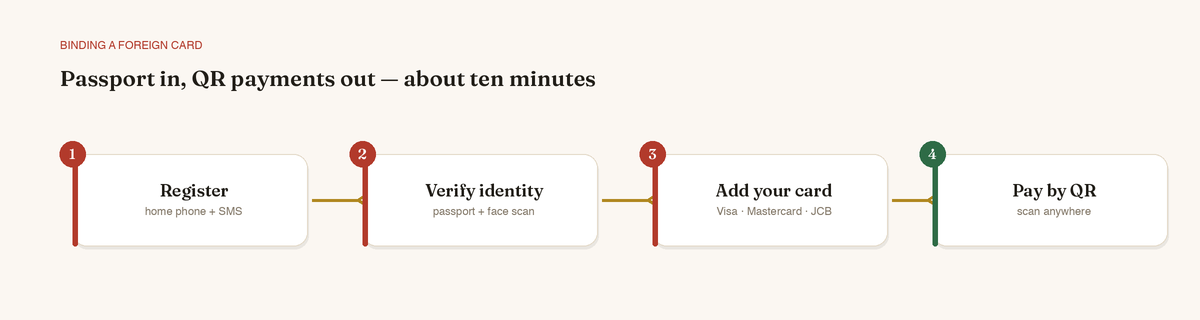
- Register with your home phone number and verify by SMS code.
- Go to Me → Settings → Account & Security → Identity Information.
- Tap Region and select your home country (choose Non-Mainland China, even while standing in China).
- Scan your passport to auto-fill your details. Enter your name exactly as printed.
- Complete the face scan.
- Go to Me → Bank Cards → Add Card, enter your card, and confirm via the OTP your bank texts you.
Verification timing: Most passport checks clear in under 5 minutes. If yours is flagged for manual review, expect up to 24 hours (occasionally 1–3 business days). Don't panic — this is routine.
Pro tip: Turn off your VPN before verifying. Alipay's servers sit inside China, and a foreign IP address trips its fraud detection — the single most common cause of "mystery" failures.
Fees: The 200 RMB Rule
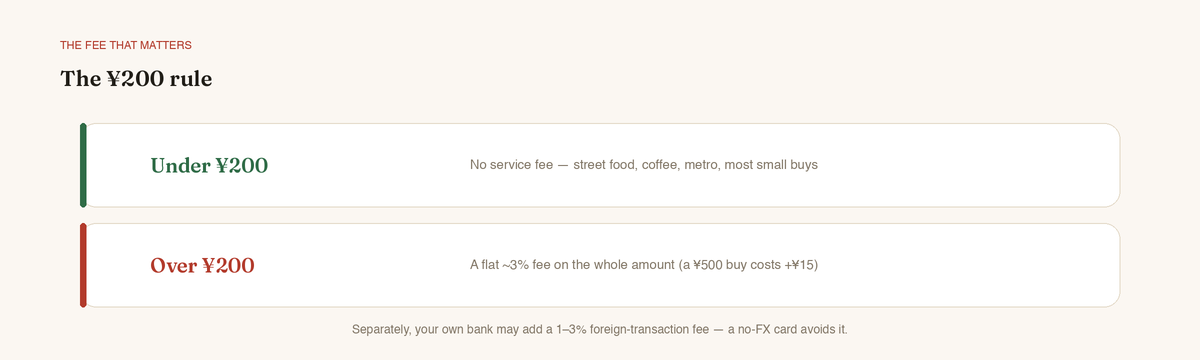
Here's the number that matters most:
- Transactions under ~200 RMB: no service fee. Most street food, coffee, metro rides, and small purchases fall here.
- Transactions over 200 RMB: a flat ~3% fee, charged on the entire amount — a ¥500 purchase costs an extra ¥15.
- Separately, your own bank may add a foreign-transaction fee of 1–3% (a no-FX-fee travel card avoids this).
Pro tip: For larger bills, ask the merchant to split the charge into amounts under ¥200 each to dodge the 3% fee entirely. Vendors do this routinely for tourists.
The Discontinued Tour Pass vs. Today's Options
Older guides mention Alipay Tour Pass — a prepaid mini-program where you loaded up to ¥2,000. It's gone. It was clunky (a deposit, a 90-day expiry, hard-to-refund balances) and has been fully replaced by direct international card binding, which is strictly better: no deposit, no expiration, higher limits, and you're charged per transaction. If a website still tells you to use Tour Pass, it's out of date.
Using It Day to Day
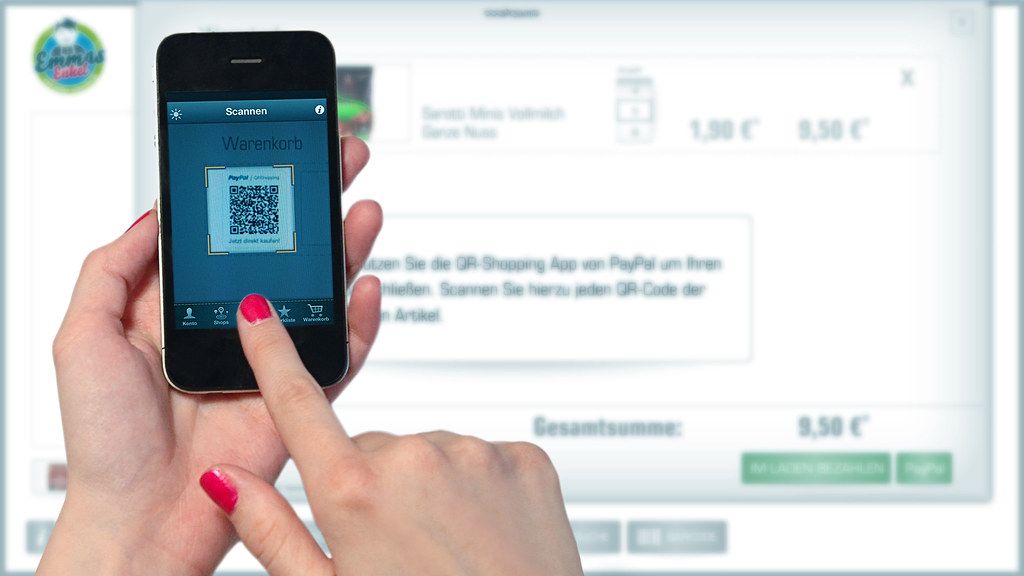
There are two scan directions, and knowing which is which saves confusion:
- You scan them (merchant scan): Open the app, tap Scan, point at the vendor's printed QR, type the amount, pay. Common at street stalls.
- They scan you (your code): Tap Pay/Receive to show your personal QR; the cashier scans it. Common at supermarkets and chains.
Other essentials: - Metro: Generate a Transport/Ride Code inside Alipay or WeChat and scan it at the turnstile — no plastic card needed in major cities. - Taxis: Use the Didi mini-program inside Alipay (English-friendly) or scan the in-car QR. - Street food & markets: Almost universally QR-based; this is where the sub-¥200 fee-free zone shines.

Cash as a Backup
Carry 300–500 RMB in small notes anyway. It's a lifeline for the rare cash-only rural vendor, a dead phone battery, or an app glitch. By law, merchants must accept cash — politely insist if needed. Keep small denominations; breaking a ¥100 note can be tricky.
Troubleshooting
- Card declined: Confirm your identity status reads "Verified." If not, payments over ¥200 will bounce. Also call your bank — many auto-block first-time China charges.
- Verification stuck: Disable your VPN, retake the passport photo in natural light with the bottom MRZ strip visible, or use the NFC chip scan (higher success rate for post-2010 passports).
- Account locked: Multiple rapid card attempts can trigger a temporary freeze. Wait, then use in-app English chat to request manual review.
Pre-Trip Checklist
- [ ] Install both Alipay and WeChat Pay before departure
- [ ] Complete passport identity verification at home (over Wi-Fi, VPN off)
- [ ] Bind a Visa/Mastercard, ideally one with no foreign-transaction fee
- [ ] Notify your bank you'll be traveling in China
- [ ] Confirm status shows "Verified"
- [ ] Pack 300–500 RMB cash in small notes as backup
- [ ] Note the ¥200 fee threshold and split larger bills
You've got this. Set up the apps over coffee before you fly, and paying in China will feel effortless from your first dumpling onward.
Sources
- Payment service guide for overseas visitors to China — China State Council (gov.cn)
- Overseas Bank Cards Accepted by Weixin Pay and Alipay — Beijing Chaoyang District
- Alipay fee for international cards and transactions — Wise
- Alipay for Foreigners 2026: Setup, Verification & Payment Guide — Hidden China Travel