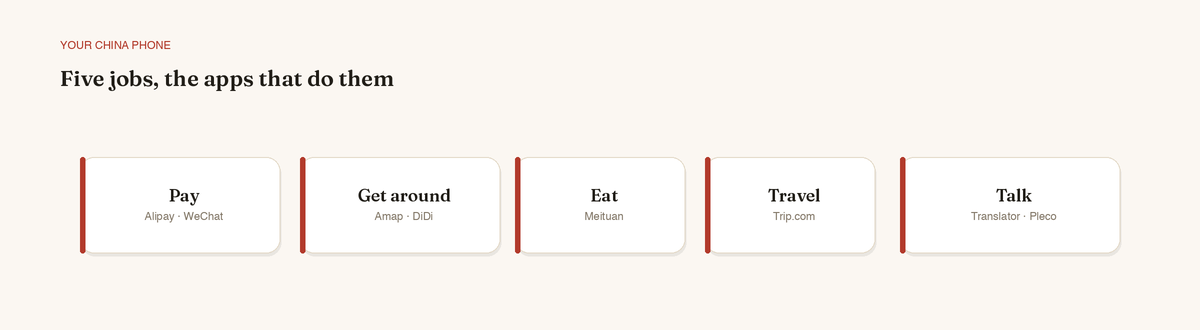
China runs on a handful of homegrown super-apps, and the tools you rely on at home — Google Maps, Uber, WhatsApp — either don't work or aren't where the locals are. The good news: a few well-chosen downloads turn a daunting trip into a smooth one, letting you pay, ride, eat, and navigate like a regular. Set these up before you fly, while you still have your home SIM for SMS codes and an unfiltered internet connection.

1. WeChat (微信)
Replaces: WhatsApp, Facebook Messenger, and half your other apps.
WeChat is the social fabric of China — messaging, voice/video calls, and a sprawling universe of "mini-programs" (apps-within-the-app) for everything from museum tickets to bike rentals. Hotels, guides, and new friends will all ask for your WeChat. It also runs WeChat Pay, which you can bind to a Visa, Mastercard, Amex, JCB, or Discover card. On fees: single payments under ¥200 are surcharge-free, but a ~3% fee applies above ¥200 (Alipay uses the same threshold). For most tourists Alipay is the more reliable foreign-card wallet, so lead with it and keep WeChat Pay as backup.
- Built-in translation: long-press any message to translate it instantly.
- Mini-programs let you order food or buy attraction tickets without extra downloads.
Pro tip: Register with your home phone number before you leave — you'll get an SMS verification code, and some accounts need a quick scan-verification from an existing user, which is easier to arrange in advance.
2. Alipay (支付宝)
Replaces: Your physical wallet — and it's the tourist workhorse.
If you download only one payment app, make it Alipay. Foreign-card binding is smoother here than on WeChat, and its built-in mini-programs (DiDi, Meituan, metro QR codes) mean Alipay alone can carry your whole trip. Bind your own Visa/Mastercard directly — the old prepaid "Tour Pass" was retired, and direct card binding replaced it.
- Accepts Visa, Mastercard, Amex, and more — no Chinese bank account needed.
- Tap Scan to pay a merchant's QR, or show your own code to be scanned.
Pro tip: Use a card with 0% foreign-transaction fees, and add it before departure so you can troubleshoot any verification hiccup at home (over Wi-Fi, with your VPN off).
3. Amap (高德) / Baidu Maps
Replaces: Google Maps, which is blocked in China.
Install AMap Global — the English overseas edition — not the plain domestic "Gaode / 高德地图" app, which is Chinese-only and demands a mainland phone number (US/UK numbers aren't accepted). AMap Global needs no Chinese number for core navigation and accepts English search input, giving you real-time driving, walking, metro, and bus directions. Baidu Maps is the main alternative. Either will route you through subway systems and show live transit times far more reliably than anything you'd smuggle in over a VPN.
Pro tip: Search by English place name or paste Chinese characters from your hotel's confirmation. Screenshot key addresses in Chinese to show taxi drivers.
4. DiDi (滴滴)
Replaces: Uber / Lyft.
DiDi is China's ride-hailing giant, and — crucially for visitors — it offers a full English interface and accepts foreign cards. Book economy cars, premium rides, or taxis; the app even has a built-in translator so you can message your driver. You can run DiDi as a standalone app or as a mini-program inside Alipay, which deducts fares automatically.
Pro tip: No Chinese number? Use DiDi inside Alipay — it skips the separate registration entirely and bills your bound card.
5. Meituan / Ele.me (美团/饿了么)
Replaces: DoorDash, Uber Eats, Yelp.
Meituan and Ele.me deliver food, groceries, and more, and double as a local-listings powerhouse for restaurants, deals, and attractions. The standalone apps are Chinese-only, but the mini-program versions inside WeChat or Alipay support English and pay with your bound card.
- No Chinese ID required — just a phone number and Alipay/WeChat Pay.
- Great for late-night meals when you don't want to leave the hotel.

Pro tip: Open Meituan via the Alipay mini-program for the cleanest English experience and seamless foreign-card checkout.
6. A Translator: Microsoft Translator or Baidu Translate + Pleco
Replaces: A phrasebook and a guessing game at the menu.
- Microsoft Translator is the best fully offline option (download the Chinese pack first) and isn't blocked.
- Baidu Translate has the strongest camera mode — point it at a menu or sign for an instant overlay, and it works without a VPN.
- Pleco is the gold-standard Chinese–English dictionary for decoding individual characters, with tones and example sentences.
Pro tip: Download every offline language pack before your flight — in-app downloads can be slow or unavailable once you're behind the firewall.
7. Trip.com / 12306
Replaces: Expedia, Kayak, and the train-station ticket queue.
Trip.com books trains, flights, and hotels in clean English, accepts global cards and Apple Pay — ideal for your first booking (a small ¥10–30 per-ticket fee). 12306 is the official railway app: free and direct, but it requires passport registration and email activation. Either way, tickets are fully digital and linked to your passport — there's no paper. One heads-up: the automatic tap-gates were built for Chinese ID cards, and only a few upgraded stations read foreign passports directly. At most stations, use the staffed "Manual Channel" lane at either end of the gates — show your passport and staff wave you through.

Pro tip: Start with Trip.com to confirm the flow works in five minutes; graduate to 12306 later to skip the service fees.
Connectivity (eSIM + VPN)
You need mobile data the moment you land — payments and maps won't run on patchy hotel Wi-Fi. The easiest fix is a China travel eSIM, which routes around the Great Firewall so Google, Instagram, and WhatsApp keep working, no separate VPN app required.
Pro tip: Buy and install your eSIM before departure. If you want a standalone VPN as backup, download and test it at home — VPN sites are blocked from inside China.
Download Checklist
Install and set up each of these before you fly, while SMS codes and the open internet are on your side:
- [ ] WeChat — registered + Pay bound + verification done
- [ ] Alipay — foreign card added + verified
- [ ] Amap (and/or Baidu Maps)
- [ ] DiDi — or confirm it works inside Alipay
- [ ] Meituan / Ele.me — via WeChat or Alipay mini-program
- [ ] Microsoft Translator + Baidu Translate + Pleco — offline packs downloaded
- [ ] Trip.com (and 12306 with passport registered)
- [ ] eSIM installed; backup VPN tested at home