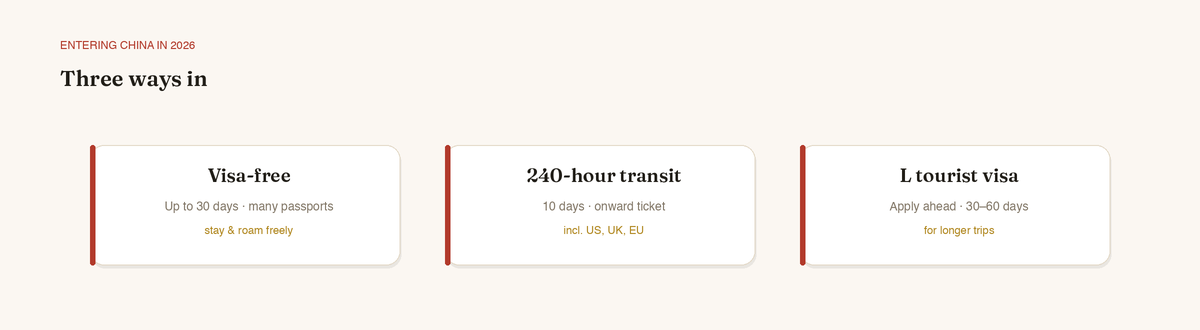
China has spent the last two years quietly dismantling the reputation that its border was hard to cross. For first-time visitors from most Western countries, 2026 is arguably the easiest year in modern history to land in Beijing, Shanghai, or Chengdu. There are now three distinct paths in, and choosing the right one before you book your flights will save you money, paperwork, and stress. This guide walks through all three, plus exactly what happens at the border.

Path 1: Unilateral Visa-Free Entry (~30 Days)
This is the headline policy and the one most leisure travelers will use. China has unilaterally waived visas for ordinary-passport holders of roughly 50 countries, allowing stays of up to 30 days for tourism, business, family visits, and transit. The trial has been extended through December 31, 2026.
Key eligible countries include: Australia, New Zealand, France, Germany, Italy, Spain, the Netherlands, Switzerland, Sweden, Norway, Ireland, Poland, Portugal, Austria, Belgium, Denmark, Finland, Greece, Hungary, and many more across Europe, plus Brunei, South Korea, and several Gulf states.
Pro tip: The United Kingdom and Canada join this list effective February 17, 2026 — a major addition. If you're British or Canadian, double-check the start date against your travel dates.
Crucially: the United States is NOT on the unilateral visa-free list. US passport holders cannot use this 30-day waiver for a normal tourism trip. Americans must use either the transit policy below (Path 2) or apply for an L visa (Path 3). This is the single most common point of confusion — don't assume reciprocity.
Path 2: The 240-Hour (10-Day) Visa-Free Transit
This is the clever workaround, and it does include US citizens. If you're transiting China en route to a third country, you can stay up to 240 hours (10 full days) without a visa.

Who qualifies: Ordinary-passport holders from 55 countries — including the US, UK, Canada, Australia, Japan, and most of Europe — with a passport valid at least three months.
The third-country rule (the catch): You must arrive from one country/region and depart to a different one. Flying London → Shanghai → London does not qualify. London → Shanghai → Tokyo does. You'll need a confirmed onward ticket (flight, train, or cruise) to that third destination within the 240-hour window.
Where: Entry through 65 designated ports across 24 provinces and municipalities, including Beijing, Shanghai, Guangzhou, Chengdu, Xi'an, and Chongqing.
Pro tip: Note that Hong Kong and Macao count as separate regions — they make perfect "third destinations" to satisfy the onward-ticket rule.
What you can do: Travel freely within and between the participating provinces. What you can't: Enter non-participating regions such as Xinjiang, Tibet, Inner Mongolia, Qinghai, Gansu, Ningxia, and Jilin, or overstay the 240 hours.
Path 3: The Standard L (Tourist) Visa
If none of the above fits — you're American on a round-trip itinerary, staying longer than 30 days, or visiting a restricted region like Tibet — you need the L visa.
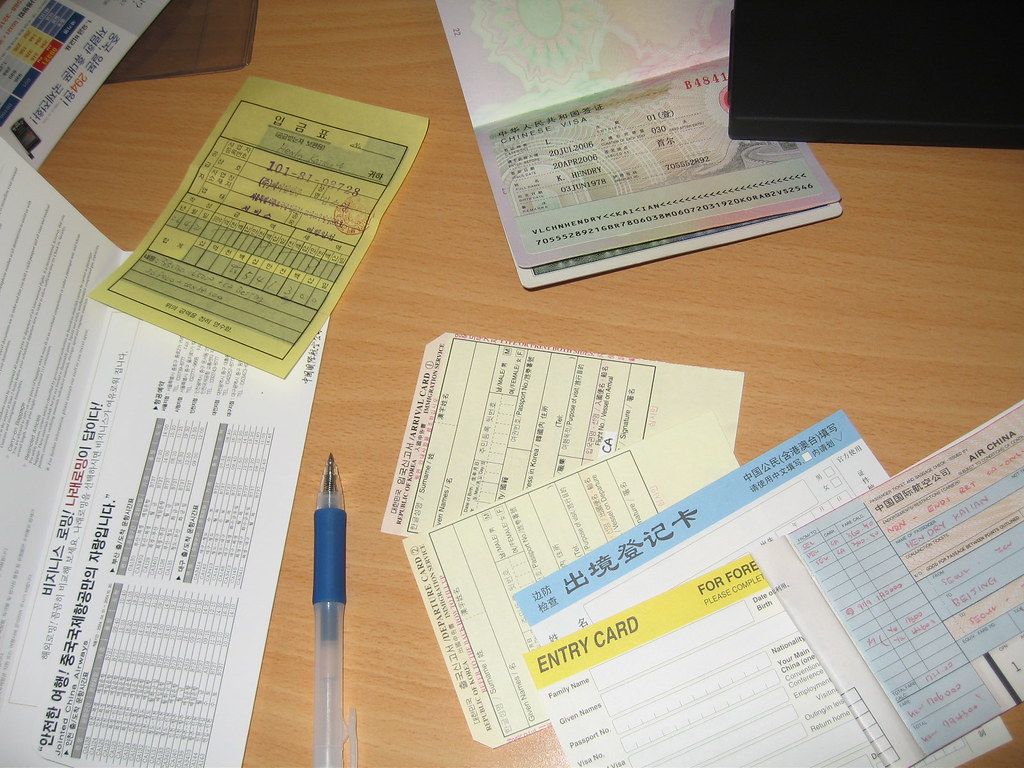
Documents typically required: - Passport valid 6+ months with two blank pages - Completed application via the COVA system (cova.mfa.gov.cn), then printed confirmation - A recent passport photo (33mm × 48mm, white background) - Proof of itinerary — round-trip flights and hotel bookings, or an invitation letter (rules vary by nationality)
Apply through a Chinese Visa Application Service Center (CVASC) or consulate. Processing is usually 4–5 working days; all-in costs run roughly USD 150–300 including service fees. Applicants aged 14–70 generally appear in person for fingerprinting.
At the Border: Arrival Tips

- Digital Arrival Card: Fill it out online before or on arrival at s.nia.gov.cn, via the NIA 12367 app, or a WeChat/Alipay mini-program. Screenshot the QR code it generates.
- Fingerprints: Travelers aged 14–70 have all ten fingerprints scanned on first entry. Quick and routine.
- Customs: Declare cash over USD 5,000 / CNY 20,000 and professional camera gear. The China Customs app lets you pre-fill the declaration.
- Accommodation registration: If you're not in a hotel (which registers you automatically), register with the local police within 24 hours.
Common Mistakes to Avoid
- Americans assuming the 30-day waiver applies — it doesn't; use transit or an L visa.
- Booking a round-trip and expecting the transit policy to work — it requires a genuine third country.
- Setting up mobile payments too late. Link a foreign card to Alipay or WeChat Pay before you fly.
- Forgetting a VPN for accessing Google, WhatsApp, and Instagram — install it at home.
- Overstaying any visa-free window — fines and future-entry trouble follow.
Pre-Departure Checklist
- [ ] Confirm which path fits your nationality and itinerary
- [ ] Passport valid 6+ months with blank pages
- [ ] (Transit) Onward ticket to a genuine third country within 240 hours
- [ ] (L visa) Approved visa physically in passport
- [ ] Digital Arrival Card submitted; QR code screenshotted
- [ ] Alipay/WeChat Pay installed and linked to a card
- [ ] Reputable VPN installed and tested
- [ ] Onward and hotel bookings saved offline
- [ ] Travel insurance arranged
Welcome to China — the gate is wide open in 2026.
Sources
- China's Visa-Free Travel Policies — A Complete Guide (China Briefing)
- China widens visa-free access in latest opening-up move (gov.cn)
- China 240-Hour Visa-Free Transit Policy 2026 (China Discovery)
- China Digital Arrival Card — Everything You Need to Know for 2026 (Koryo Tours)
- Visa policy of mainland China (Wikipedia)